Continuing on with our examination of the many forms of color alchemy, we will travel back slightly in time, to see how an artisan’s skill and eye for color resulted in a transformational material and process that changed the way color is used, to this very day.
Our story now leaps to the early 18th century, and the figure of Jacob Christoph Le Blon, a German painter and engraver, who came from a family of artists and craftsmen. His great-aunt was a well-known naturalist illustrator, while his father was an engraver and bookseller. So by nature of his family, Le Blon was exposed to both the creative side of art as well as the technical skills of printmaking and publishing, and later as student in Italy, where he learned the arts of painting and mezzotint engraving.
Engraving is the essential creative act in printmaking, where to image is inscribed directly on the substrate that is used to ‘stamp’ the image on a press. Mezzotint is a technique where an image is inscribed on a roughened copper plate, and then areas of the image are polished smooth to various degrees; when the plate is inked for printing, the rougher areas hold more color, while the gradation of smoothness holds less ink, mimicking the appearance of light and shade, which is used to model a three-dimensional appearance.
Printmaking is both art and craft, where hand work and technical production skills are required to make a successful final image. An artist’s eye is needed to create the original image directly on the plate and model the surface, while knowledge of craft is required in order for the image to be produced successfully in a print; Engravers and printmakers were the original ‘ink stained wretches,’ the work dirty and unforgiving. They were (and are) artisans who dealt with a meticulous creation and particularly fussy and messy production process.
Le Blon toiled for many years as a miniature artist in Amsterdam, painting small figures on bracelets, rings and snuff boxes in watercolor. As his eyesight began to fail, he moved to painting cabinet pictures and portraits in oil, while also training painters in the art.
His experience with watercolor was especially formative, applying layers of translucent paint to build up color appearances. It was during this time that he developed the basis for his color theory, which was derived from his own studio practice, and ‘tricks of the trade,’ or techniques that were passed around amongst painters. This was from around 1706 to 1710.
At the same time, Le Blon returned to printmaking, inspired by a new idea: making ‘natural’ colored prints. Printmakers had been adding color to their prints by making multiple plates and then inking them with different colors; early color print making used a limited number of colors and applying them in flat blocks of color, resulting in ‘colorful’ prints that had an extra appeal beyond a black and white print. That matches the progression of color application in painting, beginning with the most fundamental color application in painting, using one pigment per color.

Starting at least from the classical period in Greece, painters discovered how to mix white and black with a pigment to create tints and shades of said color, lightening it towards white or darkening it towards black. This technique was used to add the appearance of depth, while also broadening the apparent color palette of a painting.
It was also found that mixing colored pigments together could create a third color, which likewise could be extended via tinting and shading. From this lineage, a new form of color alchemy emerged, where it was discovered that an entire gamut, or color range, could be created by mixing 3 ‘primary’ colors, which were colors that could not be mixed, but when mixed together in the right proportions, would create other colors. The techniques and applications of colormixing were varied and highly dependent on the medium used (oil, watercolor, gouache, etc.)
This technique was discovered gradually, by trial and application, and was known amongst painters of Le Blon’s time in an unsystematic way. Le Blon’s inventive mind, combined with his varied background, synthesized a unique solution for creating ‘full color’ prints; he applied color theory from watercolor painting to printing by creating translucent red, yellow and blue inks. The translucency allowed light to travel through ink layers and reflect off the background sheet, with the light absorption of each layer combining to create the appearance of a full range of colors.
This is a fine example of Le Blon’s art and craft; a 1738 print reproduction of a portrait of Cardinal André Hercule de Fleury by the celebrated classical French portait painter Hyacinthe Rigaud.
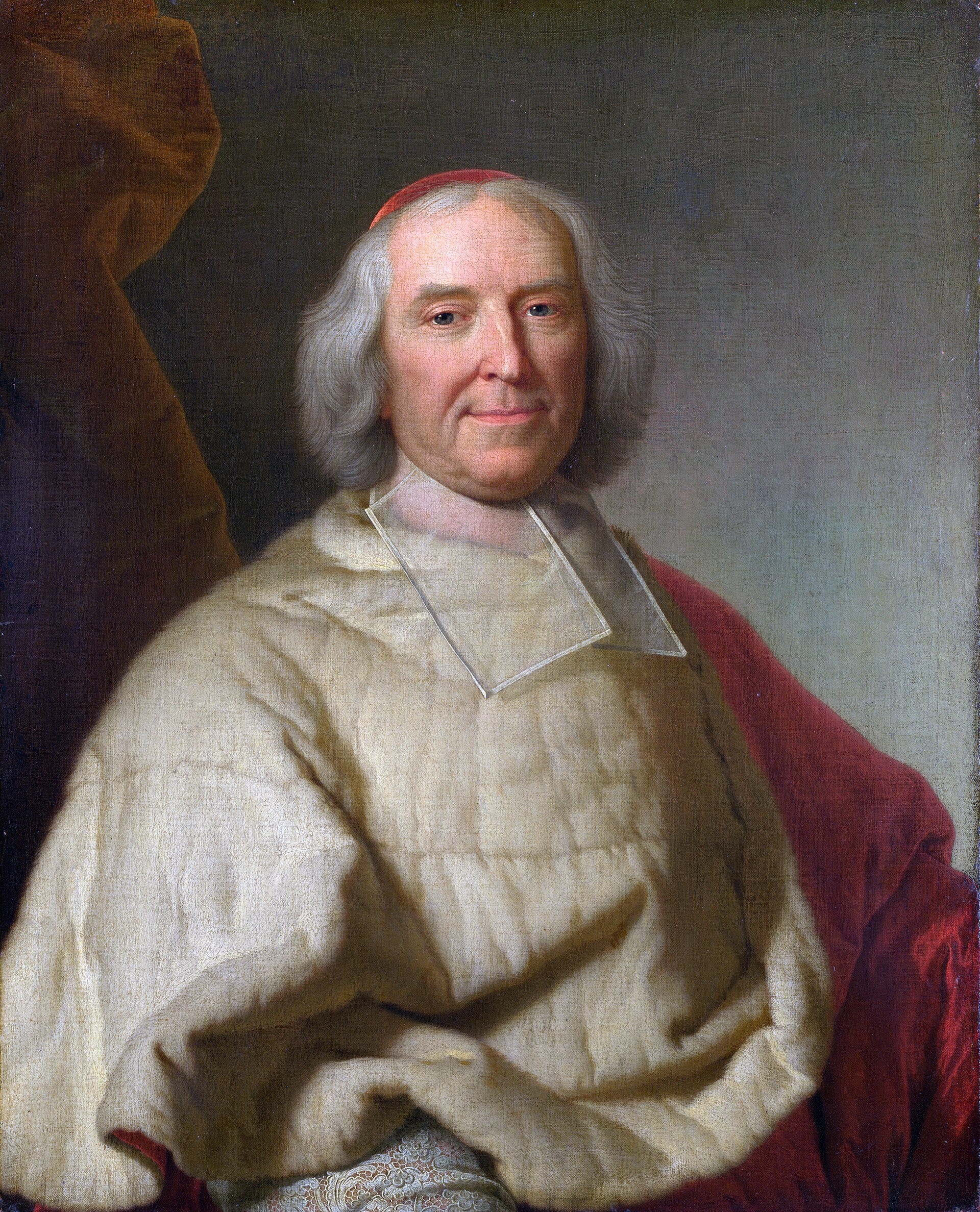
To recreate a full color image required a skilled eye for color and knowledge of colormixing, in addition figuration skills. Le Blon’s process involved creating 3 (or more) print plates, one per color. Each plate was aligned and pressed onto the sheet in turn, resulting in an image of continuous tones of varying colors. Visualizing the amount of color needed for each part of the image on each plate in order to produce the final result was a highly expert craft, the result of Le Blon’s years of experience as a painter and printmaker.
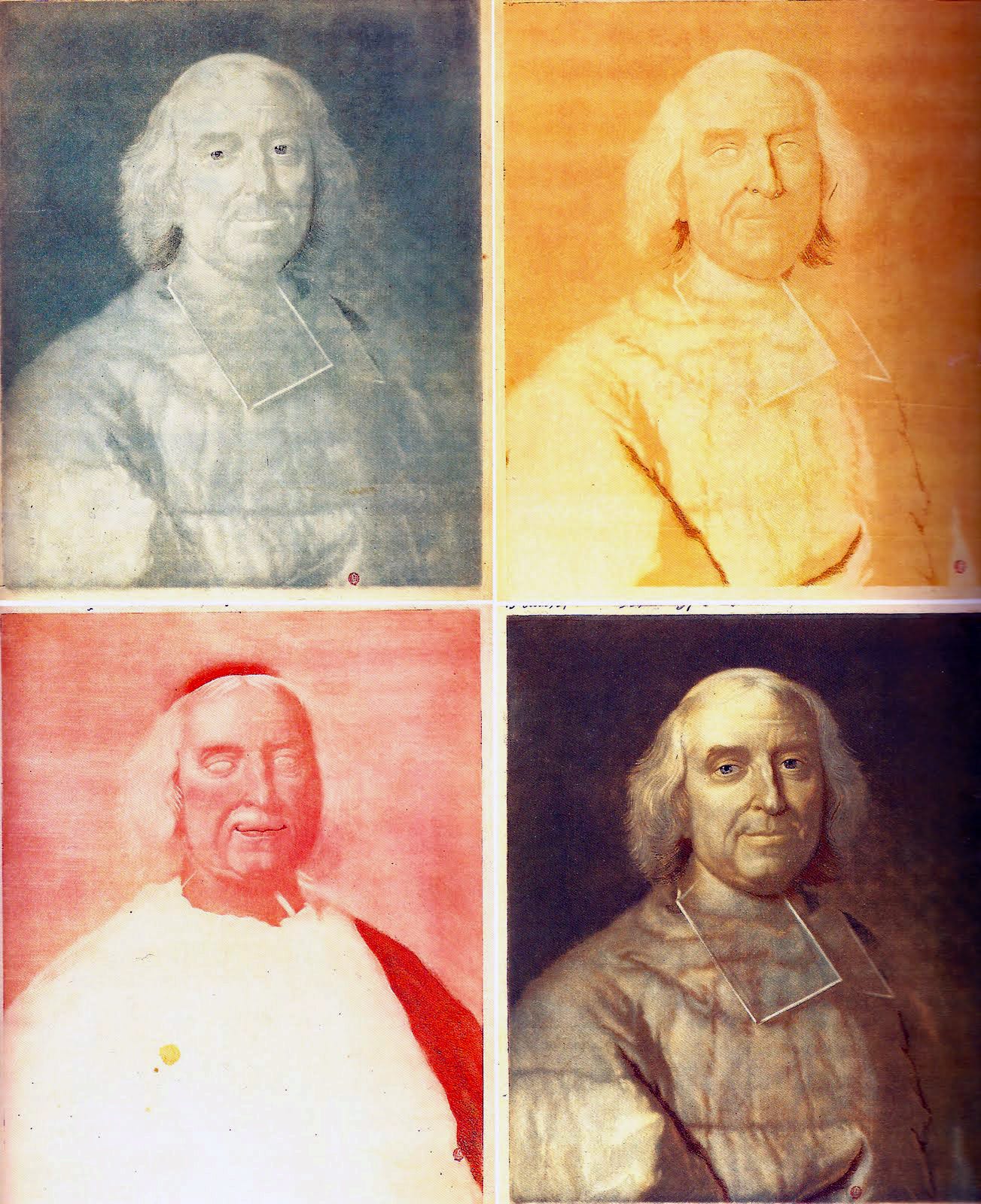
Below, you can see the individual mezzotint color plates that combined to print the full color image above: indigo, yellow, carmine, bistre, which is a brown pigment used in place of black in order to produce better flesh tones.
The understanding that was required to render the separate color plates ‘by eye’ and render them by hand is extremely impressive, to say the least!
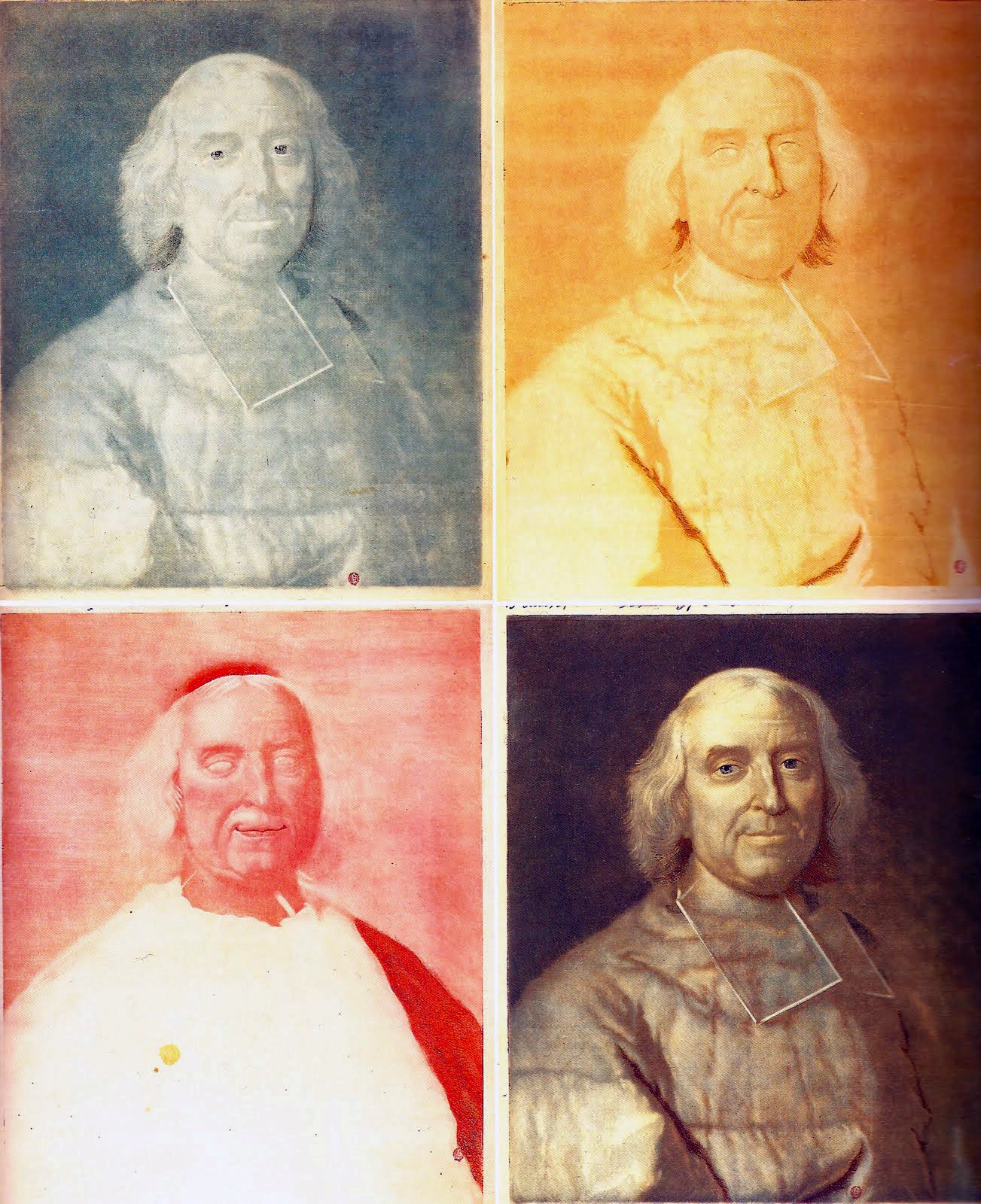
This critical move enabled Le Blon to create close reproductions of paintings that could be produced at scale. The payoff was commercial: printmaking was seen as a way to bring art to a wider audience, more affordable than an original painting, with larger print runs (editions) would produce multiple works for sale. Ultimately, the commercial side was Le Blon’s undoing, but that’s a story for another blog.

We can compare printmaking through the ages with the divide between alchemy and science. Early printmakers were closer to alchemists in that they worked by hand and eye with combining material substances in a process where the result is a transformation of appearance that belies the underlying process and materials - colored ink, wood or stone, carving tools and wooden presses. These results required a keen eye and good judgement, where experience counted more than knowledge.
And, just as science replaced alchemy, the techniques and materials of color printing became refined and standardized, enabling color image reproduction on a mass scale. While the technology became ever more elevated, the basis for modern CMYK process printing was Le Blon’s innovation. His understanding of materials, techniques and practical color theory, and how to combine them into an image making process that simulates the multi-colored world from just three colors is veritably alchemy — the transformation of base substances into the appearance of something greater than the sum of its parts. While later scientists validated and defined this process, it took the alchemy of an artist to bring it into reality.
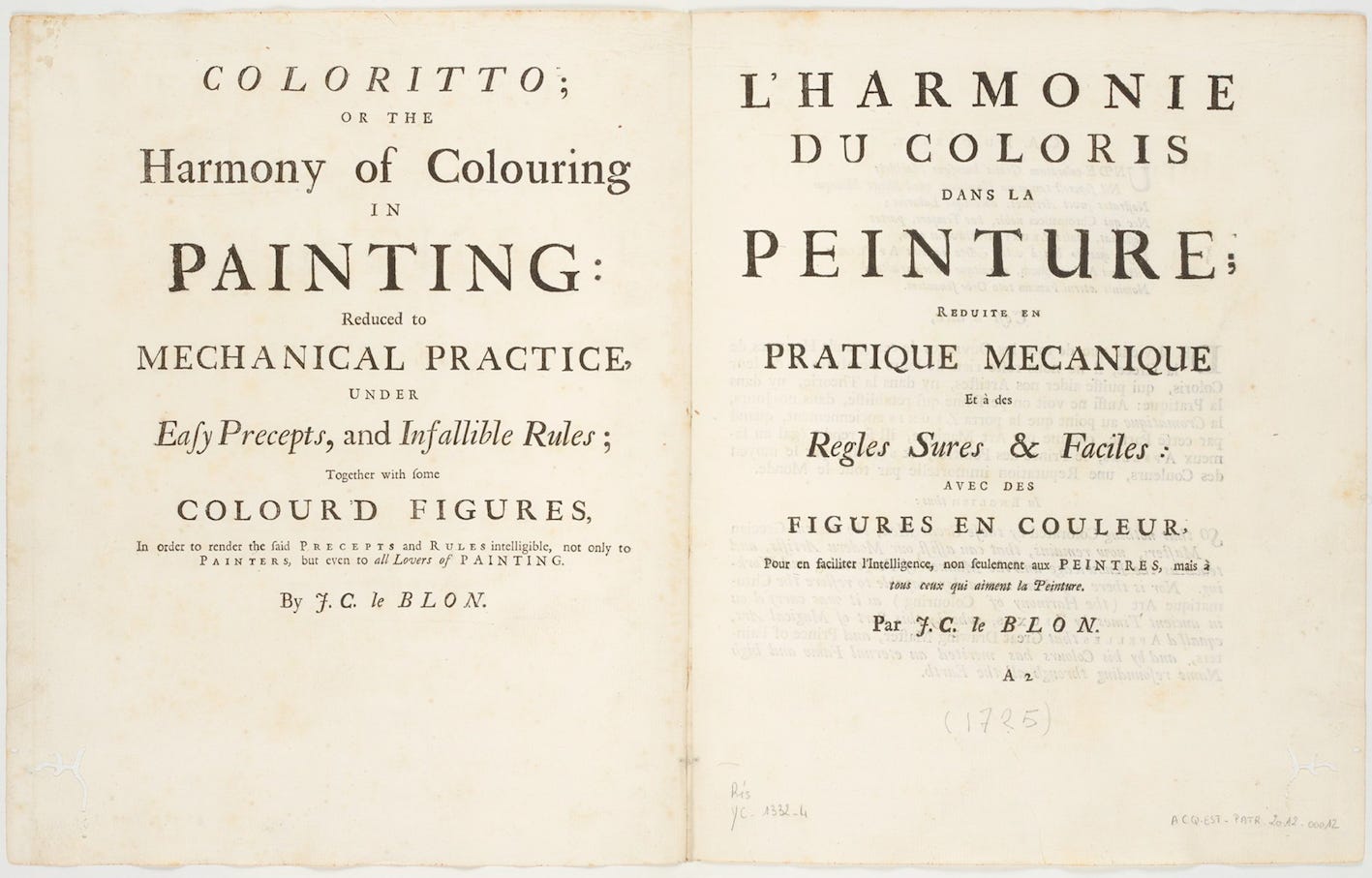
Le Blon was also famous for publishing Coloritto, his manifesto about the “Harmony of Colouring in Painting: Reduced to Mechanical Practice, under Easy Precepts, and Infallible Rules.”
Le Blon framed his invention as the re-discovery of the art of coloring that was lost since the time of the ancient Greeks. The knowledge of the ancient Greeks across all subjects was held in the highest esteem, and there was a collective pining for a return to the wisdom of those lost days. So, Le Blon was placing himself as an heir to a lost tradition of color, which he called Ars Chromatica, a name drawn from Du Fresnoy in his poem De arte graphica in 1668.
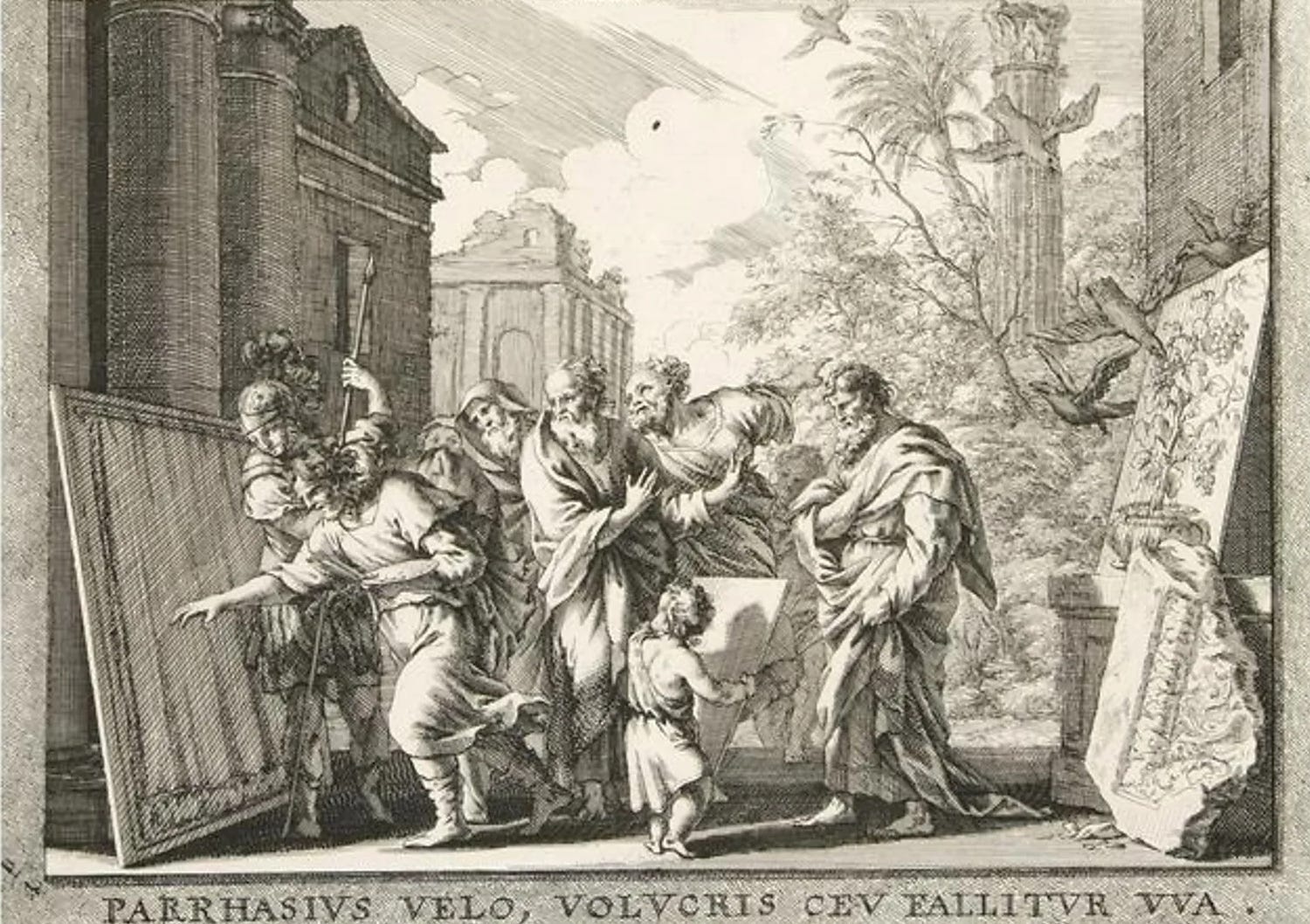
Du Fresnoy traced the art of coloring to the ancient Greeks, calling colouring Chromatice, the third part of painting, and lamenting that it died with Zeuxis, hailed as the greatest colorist of the classical era, ‘whose grapes were so lifelike that birds tried to eat them.’ Roger de Piles translated it into French as l’art chromatique. Dryden’s 1695 English version gives “the Cromatique or Colouring,” while Le Blon also refers to it as the Chromatique Art.
All of this was happening as part of an ongoing academic fine arts debate between disegno versus colorito, first in Italy in the 16th century, and later in 17th century France. A huge topic that deserves its own treatment some day.

On the very first page of Coloritto, shown here, Le Blon plainly states his thesis; that by mixing three primary colors, any color can be represented. Here, he distinguishes between Material Colours used by Painters, and primitive Impalpable Colours, or light-based Colours, one of the earliest distinctions between the two types of color, and notably places them in opposition to each other, by virtue of Material Colours mixing to black and Impalpable Colors mixing to white; a key recognition of the factual difference between paint and light.
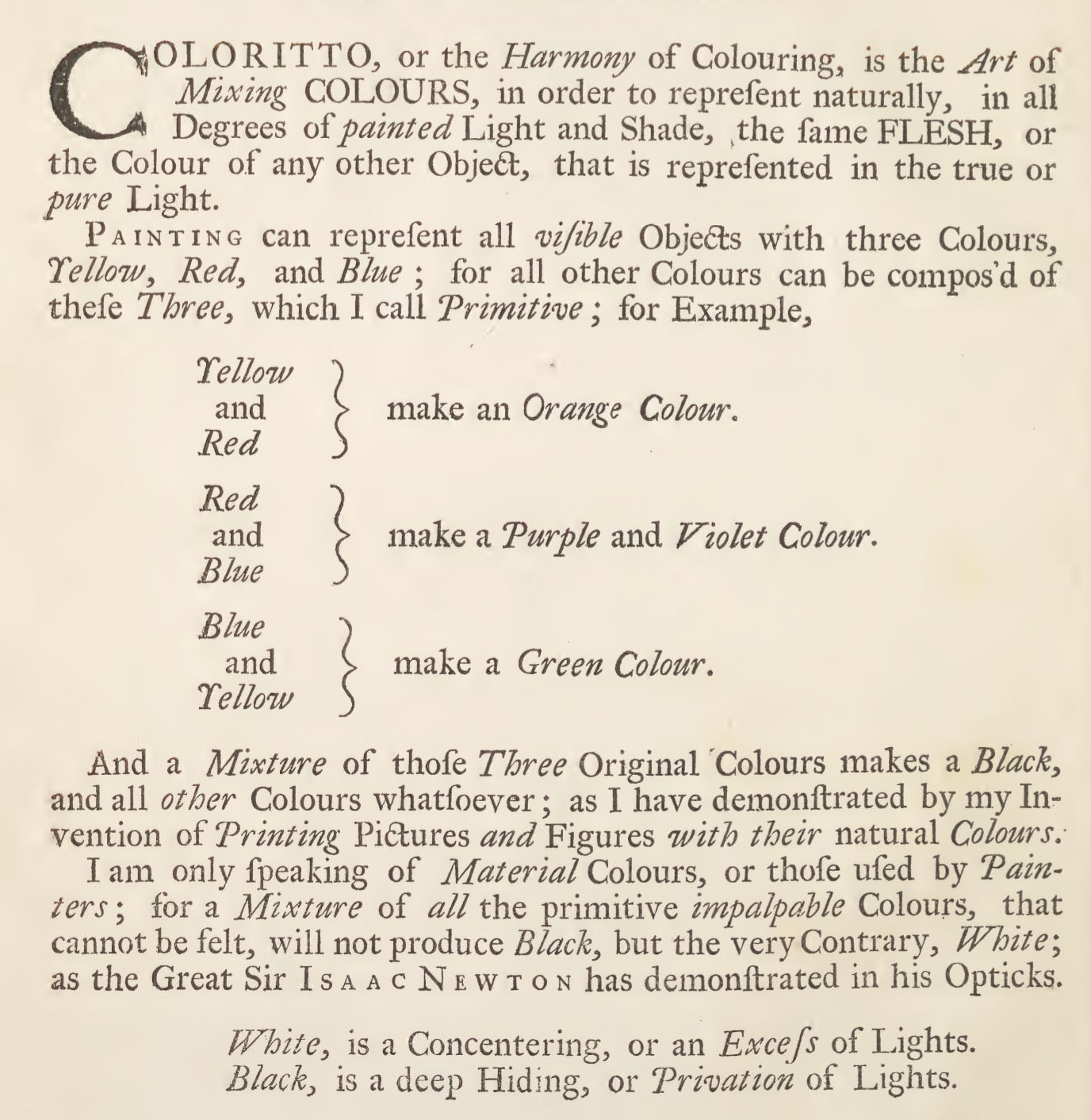
Here, then, is the basis for painter’s color theory, Red-Yellow-Blue colormixing, the foundation that is still relied upon. Le Blon also reveals the material colourants his method relies upon are Tinctures, or translucent pigments, the common thread to his full-color printing process. He discusses how this translucency is key in building up a depth of color effect and the appearance of colormixing. One hidden trap to note here, while RYB colormixing works with any pigments, many pigments are opaque, and therefore, the applied color will lose the effect of depth and layered colormixing, and appear flat.
Le Blon also addresses the importance of white and black for highlight and shade, how to create Mezzatinta, or a half shade, and the coloring of shadows. He then spends most of Coloritto addressing the coloring of flesh, according to his belief that flesh tone is the hardest to achieve, and after that, achieving any other color is easy in comparison.

The impact of Coloritto at the time was not great, distribution was limited, and the publishing mainly meant to burnish Le Blon’s reputation as a painter-theorist, rather than a printmaker, which was a much lower social station. In 1731, the Royal Society printed Cromwell Mortimer’s account of Coloritto, which ended up being the main route by which his ideas reached natural philosophers. Later in the 18th century, Le Blon’s methods and reputation grew due to Montdorge’s inclusion of Coloritto in L’Art d’imprimer les tableaux (1756), which carried Le Blon’s ideas to a far wider readership than the original edition ever reached.

Today, Coloritto stands out as one of the earliest accounts of systematic red, yellow and blue colormixing for painters. These methods were known informally, but this printed account marks a milestone in color history. Together with his invention of process printing, it makes Le Blon one of the most significant figures in the history of color; a man who united paint and print in an alchemical process that conjured three colors into a full color palette.