Previously in our search for the alchemy of color, we met Goethe through the dark lens of his failure in the scientific world. This is an ironic and unfortunate legacy, yet a poetic one that should not diminish his many accomplishments. The greatest minds are often those that are most capable of overreach, to see great heights only to long for greater visions of what lies behind and above.
This episode will examine the alchemy of color allegorically, through the looking glass viewing Goethe as the personage of his most famous work, the epic poem and play, Faust, which is itself based on a classic German fable:
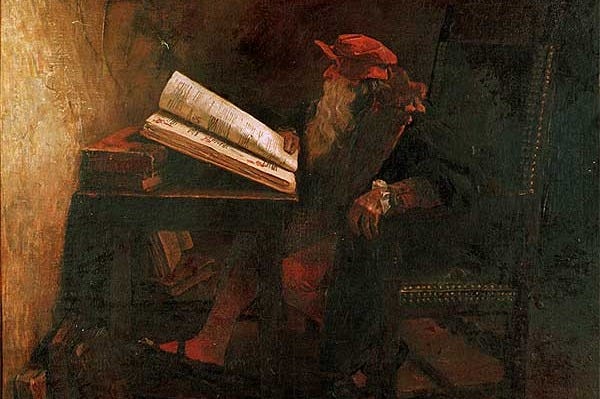
According to legend, Faust was a brilliant and successful man, who yet was unsatisfied with his accomplishments, and thus sought to make a deal with the devil, exchanging his soul for unlimited worldly knowledge and pleasures. His downfall was his elevation of human knowledge above the divine. A brilliant scholar, Faust was embittered by the limits of science, theology, and the humanities — and in Goethe’s version, the traditions of theology, philosophy, medicine, magic and alchemy.
The story of Faust has been told and retold, and yet Goethe’s version was so epic that it has become synonymous. It is a story with profound moral and spiritual lessons, unfortunately outside of our scope here. In our short time, the goal is to examine the allegory of Faust with Goethe’s own experience with color.

Previously, we learned of Goethe’s historic quarrel with Newton, and the cost to his credibility. With all the arrogance of Faust, Goethe ironically accused Newton publicly of placing scientific theory above human sensory experience:
Goethe was convinced that Newton's experimental methods and geometrical models of color mixture were a kind of falsehood machine, a delusional maze, an insane and malign procedure for fabricating nonsense that caused many scientists of his time literally to abandon their senses. For Goethe, the sensory experience of color was the fundamental basis for his science, and sensory experience was equivalent to reality.
— Bruce MacEvoy
This is a remarkable statement by one of Goethe’s contemporary critics, because, among other implications, it locates Goethe within the tradition being described by The Alchemy of Color. Goethe explicitly champions the human sensual perception of color. Goethe’s methods of investigation were primarily intuitive, rooted in Nature, and aimed at a holistic explanation of color perception beyond surface properties.
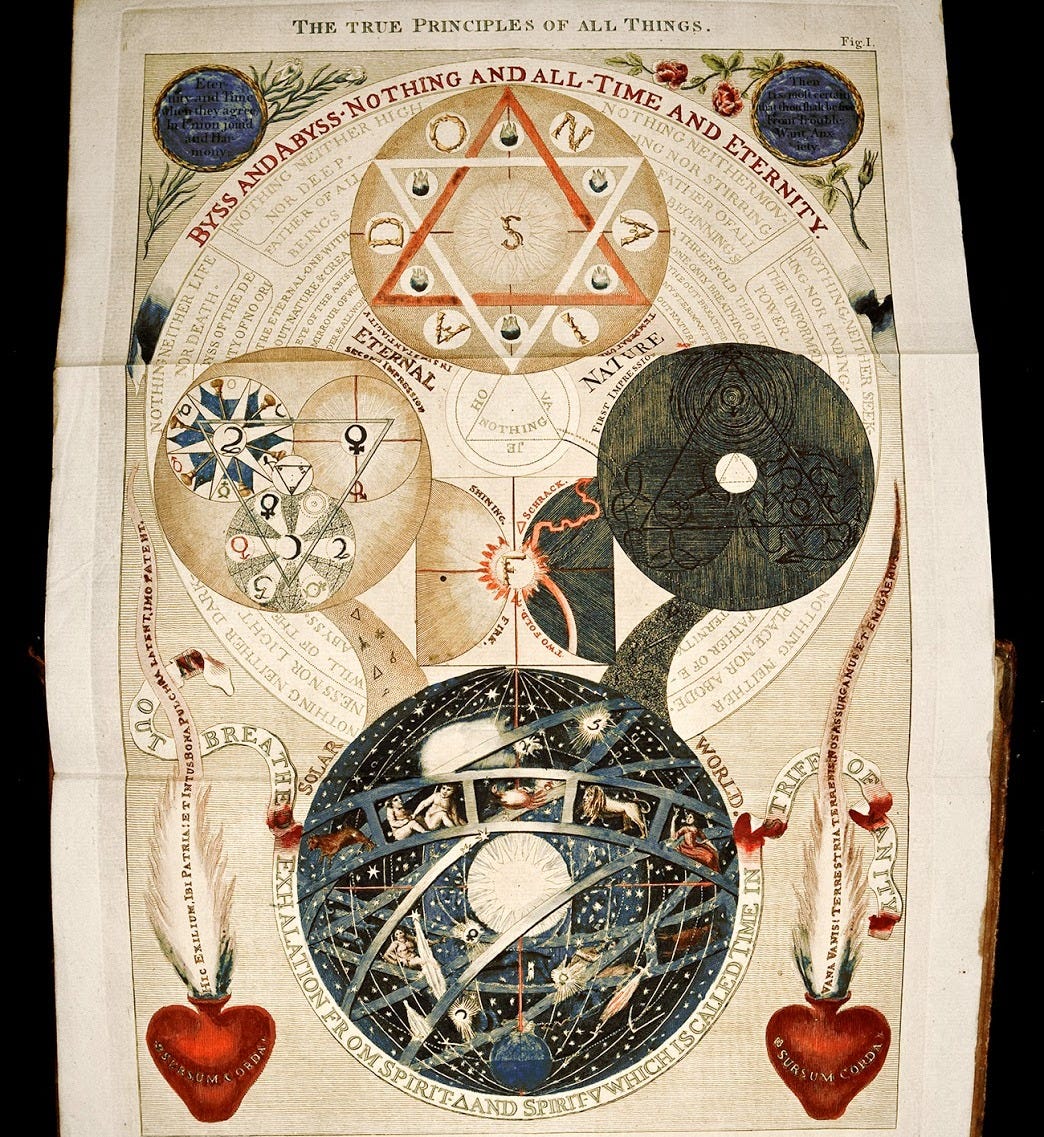
Many of Goethe’s critics have been baffled by his seemingly quixotic approach, and unconvinced by his wooly explanations of physical phenomena. Yet, when viewed from the perspective of alchemy, this characterization turns instead to a pursuit of the alchemical foundations of color experience.
While Goethe is well known for his accomplishments in many fields, what is less well known is that he had an education in alchemy, and, in fact, it informed much of his life’s work. Goethe's connection to alchemy and hermeticism began during a convalescence in his early twenties, when he studied alchemical and mystical texts alongside his mentor Susanne von Klettenberg, including Georg von Welling's Opus Mago-Cabbalisticum et Theosophicum, and works by Paracelsus, Basil Valentine, Jan Baptist van Helmont, and Jakob Böhme. This wasn't passive reading; he worked hands-on in a private laboratory under Welling's guidance, producing substances like liquor silicum.
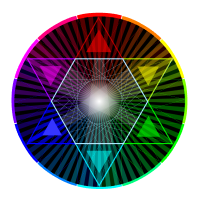
What he retained were the concepts at the root of alchemy: opposing forces and the process of transformation. In the case of his color studies, Goethe equated the appearance of color ‘polarities’ (the special visual quality of opposing colors) with the quality of ‘attractiveness’ which was also present in a magnetic field. This is the heart of Goethe’s conception of ‘magnetic’ colors.
At the center of that early study sat a single idea: that everything meaningful in nature arises from opposition — light against dark, force against counter-force; with full being realized only in conjunction with stands against it. This was not incidental to the alchemical texts Goethe read; it was foundational organizing logic. Sulfur and mercury, sun and moon, fixed and volatile. Alchemy's entire vocabulary is built on paired opposites that must come into contact before anything new can emerge.
Goethe carried this habit of mind into everything he studied afterward, color included. His famous claim that yellow is light softened by darkness, and blue is darkness weakened by light, is not simply a physical description, it is the same alchemical logic of opposition, restated as optics. Where Newton saw color as something already contained within light, waiting to be separated out, Goethe saw it as something generated — the product of two opposing forces meeting at a boundary, exactly as his youthful reading had taught him how nature works.
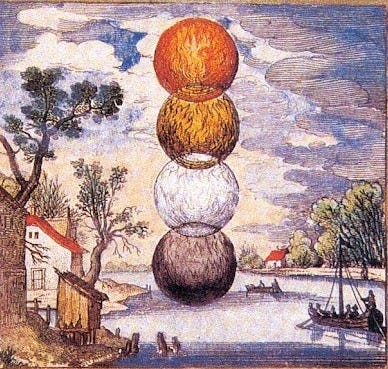
Alchemical tradition describes the Great Work as a sequence of color stages the base matter passes through on its way to perfection:
Nigredo - a blackening, the material broken down to its raw state
Albedo - a whitening, the purification that follows
Citrinitas - the yellow operation, the awakening of matter
Rubedo - a reddening, the final stage marking completion — the achievement of the Philosopher's Stone itself.
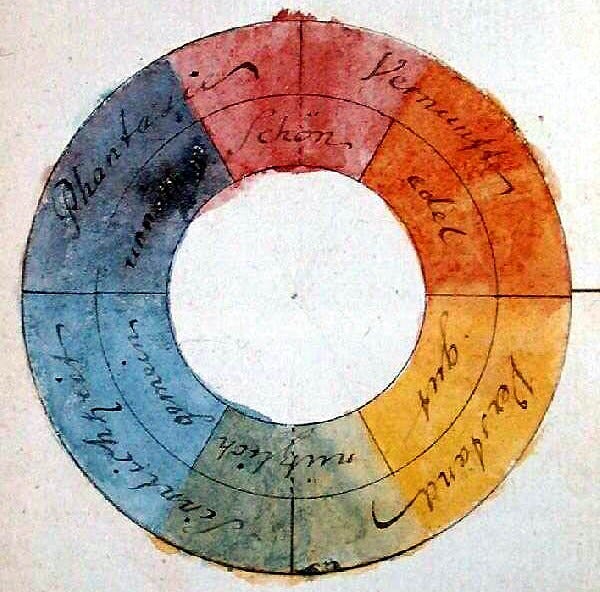
In his 1952 book Goethe the Alchemist, Ronald Gray makes the connection explicitly, arguing that Goethe's own elevation of purpur, the reddish violet which he placed at the culmination of his color circle as the union of both poles of the spectrum, echoes this same alchemical structure: not just one hue among others, but as the point where opposition resolves into completion.
If Gray is right, Goethe wasn't just borrowing alchemy's logic of opposites for his color theory — he was, consciously or not, giving that opposition the same ending the alchemists always gave it. Purpur isn't an arbitrary stopping point in his system; it's occupying the same structural role — completion, culmination — that rubedo occupies in the Great Work.
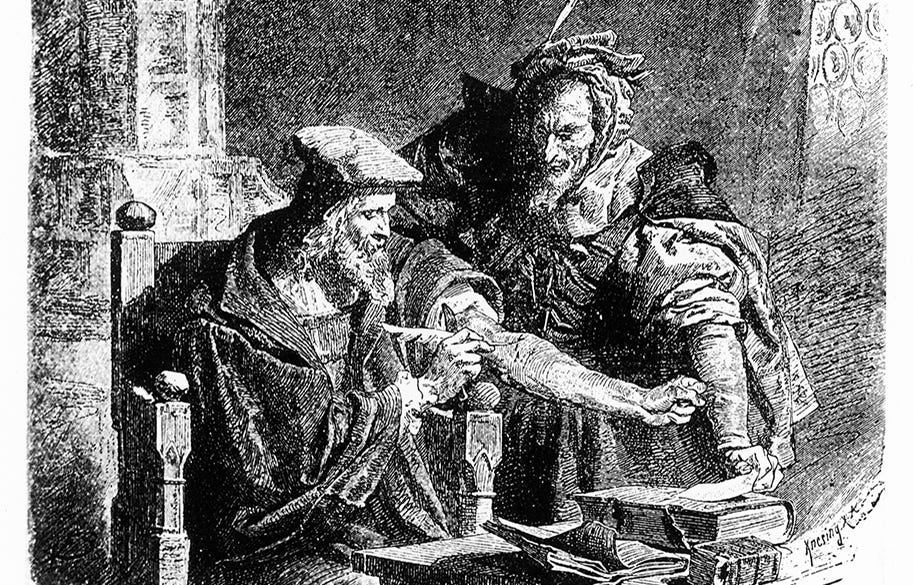
Returning to the Faustian theme, Goethe himself was frustrated with what he saw as the limits of scientific knowledge, convinced of the superiority of his own intellect and his own way of seeing. Faust, too, was no stranger to any of this. When Goethe's play opens, Faust is not a young man setting out, but an old one looking back, a scholar who has mastered philosophy, law, medicine, and theology, and finds himself no closer to what he actually wanted, which was never facts, but understanding; not information but the thing itself.
A lifetime of learning has left him standing exactly where he started. It is this restless despair, not simple ambition, that opens the door to Mephistopheles — a man who has exhausted every way of knowing and yet yearns for more. This yearning is not a flaw to be corrected; it is the engine of the whole story, the thing that makes the bargain not just possible but necessary — to Faust and Goethe alike.
Something in the experience of color reaches people, and drives some of them to want to go further into it; the scientist reaches for it through explanation, the artist through recreation, the rest of us simply by surrounding ourselves with colors that speak to us.
Goethe wanted all three at once: to explain color, to feel it, and to be believed as an authority. So he took his case to the public, staking his reputation on the wager that all three could be held by one man, in one lifetime, in one book.
Whether he actually held all three, or only ever grasped one, is the question the rest of this story arc has to answer.