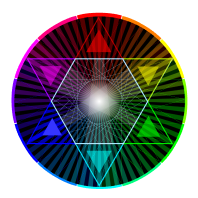
The search for the alchemy of color has taken many forms. In its purest original sense, the alchemist’s search for The Philosopher’s Stone was a search for a unifying, generative principle capable of explaning and transmuting everything else — the prima materia. Newton came close by splitting white light into the color spectrum, which was foundational in defining the physical origin of color. Following Newton, another polymath attempted to define the prima materia of color, Johann Wolfgang von Goethe.
Goethe was a man of many talents, a novelist, poet, philosopher, and natural scientist (and, interestingly, a Freemason). Highly educated, well traveled and with a wide range of interests, Goethe is rightly considered one of the great minds of mankind.
With a protean work output, and most famous for his epic poem, Faust, Goethe himself considered his book Zur Farbenlehre (On Chromatics or The Theory of Colours) to be his magnum opus, a volume containing Goethe’s experiments with the physiological perception of color, and expounding on his metaphysical theory of color’s origin, and the psychological / moral system of color classification.
Never known for his humility, Goethe described himself as, “the only person in this century who has the right insight into the difficult science of colors, that is what I am rather proud of."
Goethe’s legacy in color is large, but complicated. How close did he come to the alchemy of color?
Just as Newton sought correspondence in physics, Goethe was preoccupied with philosophy, with a worldview of God as master technician. Thus, Goethe’s conception of light and dark was not purely based in physics, but in metaphysics, and the historical legacy of Aristotle.
One of Goethe’s significant contributions to the study of color were his writings on the psychology of color. Guilty of intellectual overreach and misplaced confidence, Goethe overextended himself to attribute certain human personality traits to colors.
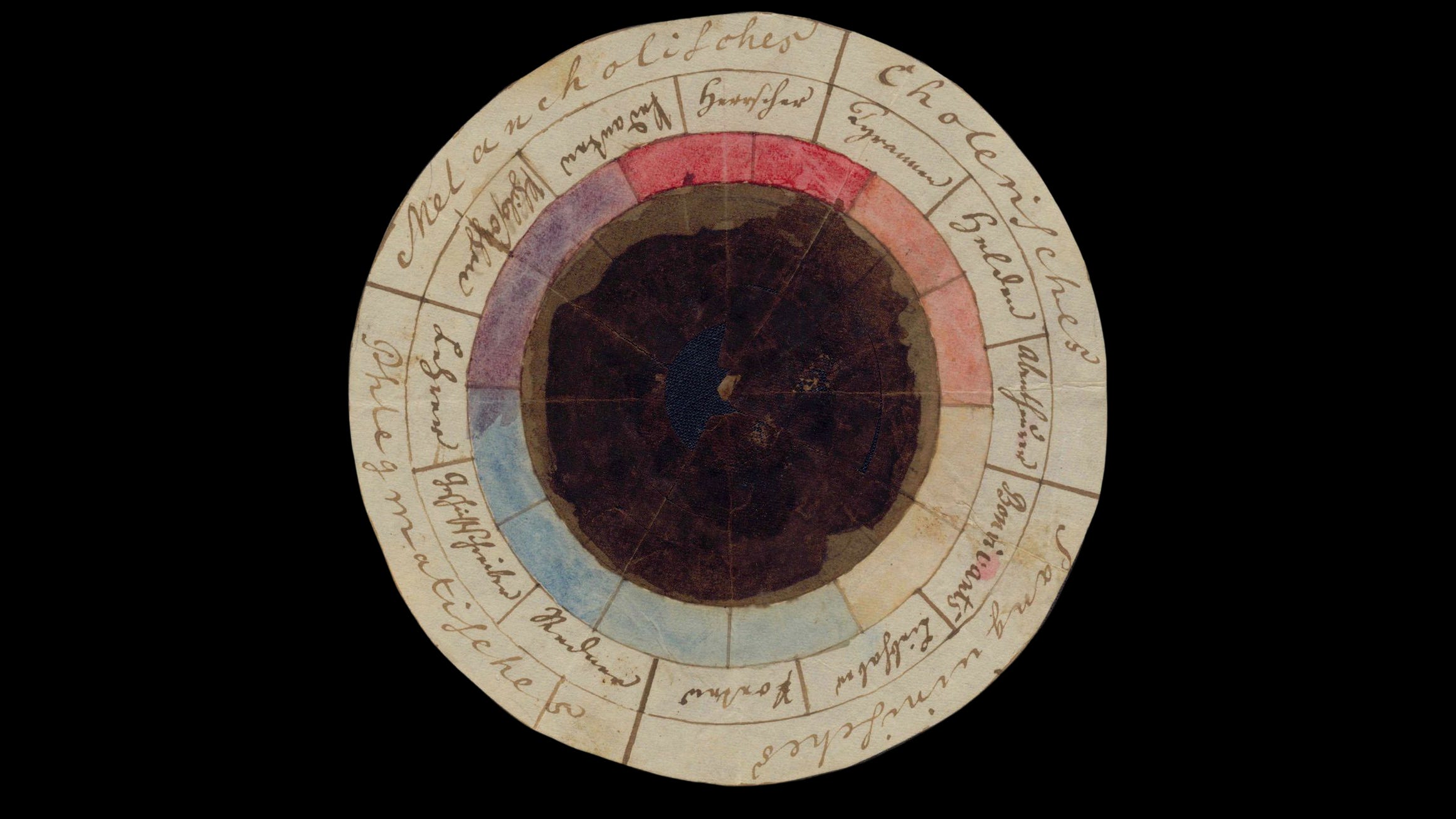
Goethe and his collaborator, Friedrich Schiller extended ancient Greek medical theory into what they called the Temperament Rose (shown above), mapping the entire color spectrum onto the four humoural types, then further subdividing each temperament into specific human roles or archetypes (tyrants and heroes under choleric, poets and lovers under sanguine, teachers and historians under phlegmatic, philosophers and pedants under melancholic).
For example, he described pure red as a hue that “conveys an impression of gravity and dignity” — one of the traits he mapped onto the “choleric personality” type in his broader scheme linking the twelve hues to the ancient four temperaments (choleric, sanguine, phlegmatic, melancholic) that were defined by the ancient Greeks.
We can see more evidence of his color overreach with the ‘Goethe Triangle’ studies. Despite popular belief, Goethe himself never used the color triangle form; instead, later generations mapped his classificiations onto the triangle (a well known color illustration method), producing very authoritative diagrams of color relationships.
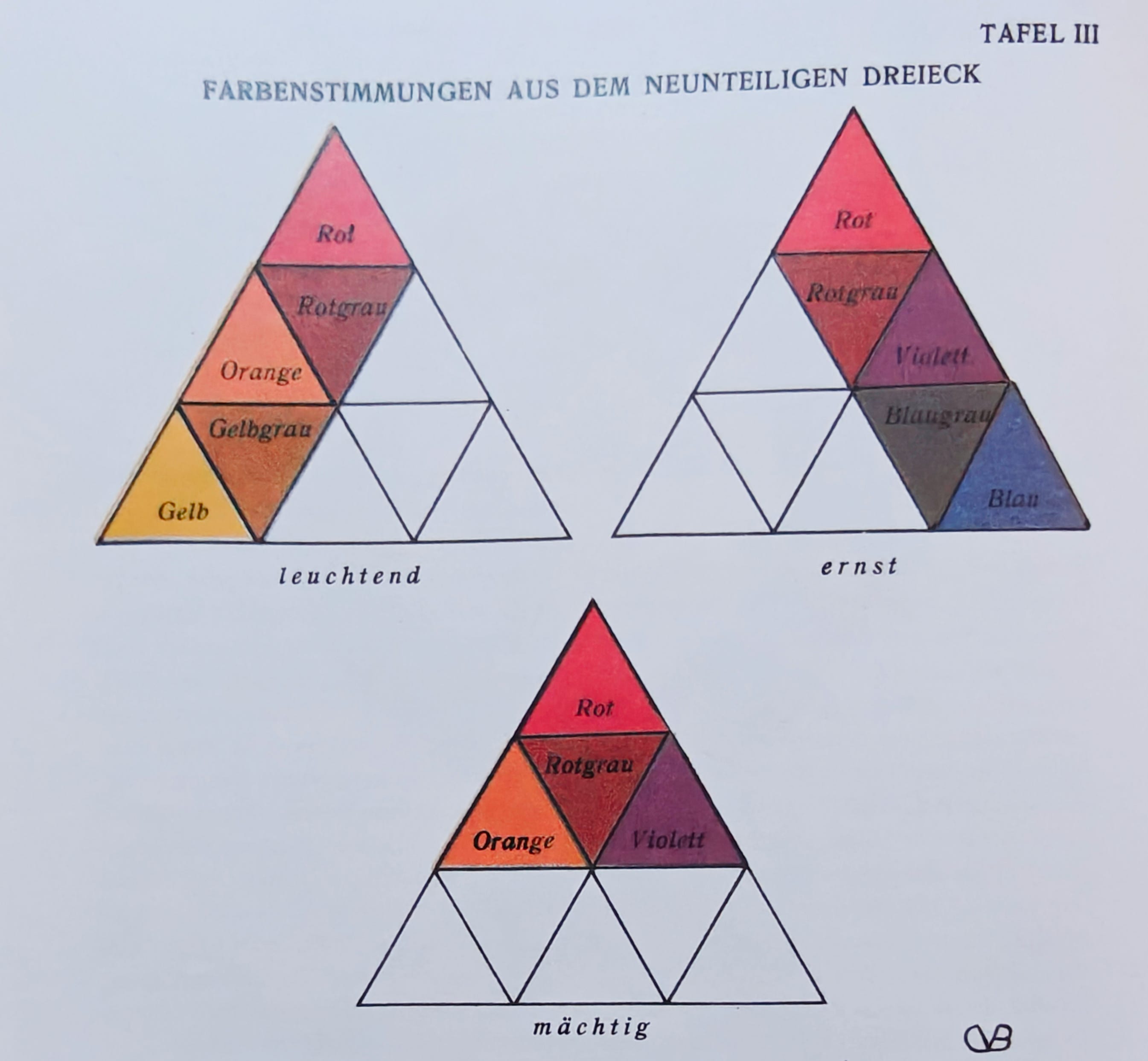
Popularized by the artist and educator Carry van Biema in her 1930 book, Farben Und Formen Als Lebendige Kräft, the ‘Goethe Triangle’ represents Goethe’s psychology of color even if he did not create it directly; the color diagrams are meant to illustrate vibrant (leuchtend), severe (ernst), and powerful (mächtig) color combinations. While one may instinctively and generally relate these color combinations to Goethe’s definitions, in fact they are closer to horoscopes — generalized statements that invite the viewer to read their own truth into them.
Note: I am greatly condensing the information around the ‘Goethe Triangle.’ For a deeper dive into this topic, see this excellent article: Goethe’s Color Triangle - A Didactic Phantom
What is obvious in retrospect is the mapping of color on to the human personality is extremely subjective. Unfortunately, there is a long history of pseudoscience in this area, where confident definitions are made about the symbolism and physiological effects of color. In hindsight, it is easy to see how these assertions are culturally biased, and are little more than poetic license applied to color. Goethe, however, with the confidence of his supreme intellect, was certain about his assertions.
This is the first visual in The Alchemy of Color that represents a seductive but dangerous illusion; a visual arrangement of colors that assumes an air of authority, and so is received as fact by the viewer. This is how confident but faulty assertions about color have been passed down through generations.

Despite his background in the humanities, Goethe considered his color investigations to be scientific, and demanded that his findings be treated as such. He set himself up in opposition to Newton, contending against Newton’s experimental findings that colors are properties of light, by declaring that colors resulted from the interplay of light and darkness, and attempting to back up this assertion with his own phenemonological findings.
Goethe experimented with a prism, but used his observations to arrive at a different conclusion, which supported his hypothesis. His prism observations followed the same logic: color appears at light-dark edges — white above dark stretches a blue-violet edge into the dark, dark above light stretches a red-yellow edge into the light — and he held that the spectrum itself was a combination of these simpler edge effects, making Newton’s spectrum a derived phenomenon rather than fundamental.
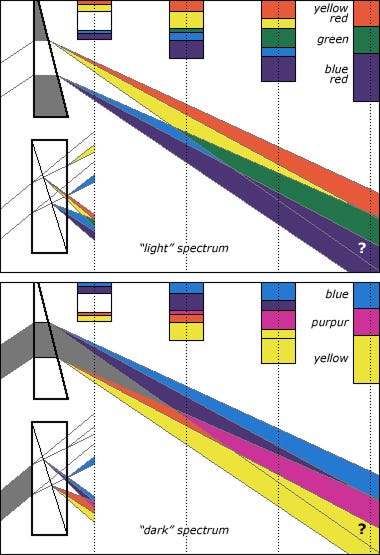
The above image, adapted from Plate IV, Figures 1 and 2 of Zur Farbenlehre, was presented by Goethe as proof of his theories. Scientists of the day were unconvinced, and thoroughly debunked this example, by noting, among other problems, that his observations were based on a fixed viewing length, while different viewing lengths did not support his hypothesis. Thus, despite his fervent desire, Goethe’s color work was dismissed as science.
Note: I am greatly condensing both Goethe’s work, the color theory and history surrounding it. For a deeper dive into this topic, see this excellent Theory of Colours analysis.

At a higher level, we can see the arc from natural philosophy to alchemy to science; the study of natural philosophy is largely observational, while alchemy attempted by diverse means to discover and derive the base elements that cause natural phenomena, while science evolved as a codified methodology for investigating and quantifying hypotheses in order to arrive at conclusions with repeatable results.
Science can thus be described as a form of unequivocal knowing. It is authoritative in a material sense. The certainty of science and the results derived from its findings has elevated science to a position higher than other forms of investigation, which hinge on less rigorous or proveable means. So, there is an implicit bias towards scientific thought as being superior, a higher bar of truth.
The means also matter, with objective experimentation winning out over personal observation and logical thought. It’s no wonder then, that during the Enlightenment through the present day, that great minds would gravitate towards science as being the pinnacle.
Goethe certainly thought so, and sacrificed his reputation attempting to summit the science world.
The primacy of science from the age of Enlightenment until now has been so strong that its quest for quantified objectivity has obscured other paths to understanding. Science can measure, define, and predict a great deal; but there is much it cannot capture. It can explain color after the fact, and it can explain a color in isolation; it cannot manifest the experience of color. This represents the limits of science.
The Alchemy of Color is the phrase I’ve coined as a means of symbolizing the experience of color; for me, the alchemy of color is experiential, and not something that can be arrived at scientifically or mathematically. That is to say, it exists as an outcome of experience, rather than a formula. The scientist can formulate colors, but they can’t formulate the experience of colors. This experience is the domain of the viewer and the artist.

So while it appears that Goethe failed in his quest for defining the prima materia of color, in the next installment, we will investigate how Goethe actually did reveal the alchemy of color through his work. Excelsior!