“With color one obtains an energy that seems to stem from witchcraft.”
—Henri Matisse
Color is a universal phenomena, permeating our very existence; color is deeply embedded in the human experience at every level, from daily life to extraordinary events. In its everyday role, color performs myriad utilitarian functions. We use color in many ways, to tell us if the stove is still hot, or when to stop or go at the traffic light.
However, there are also moments when color transcends its boundaries and asserts its remarkable power. These moments reveal the mysterious beauty of color, touching something that is deep inside us all. That moment of transcendence reveals the alchemy of color.

Humans respond to the power of color naturally, and have endeavored throughout history to harness this power and employ it in their own products, designs and artworks. To do this requires two things: color substances and color application — the art of working with color.
Color substances are the physical color means that artists and designers work with. From early natural resources such as charcoal, berries and ochre, man learned to create dyes and pigments through increasingly sophisticated methods. This early chemistry was a form of alchemy that eventually morphed into scientific practice. Today, digital artists and designers work with the substance of light, Red, Green and Blue photons.
The third act of alchemy, and the most elusive, is the act of creating with color, using it expressively to dazzle the mind's eye and invoke the power of color. This is the alchemy of art.
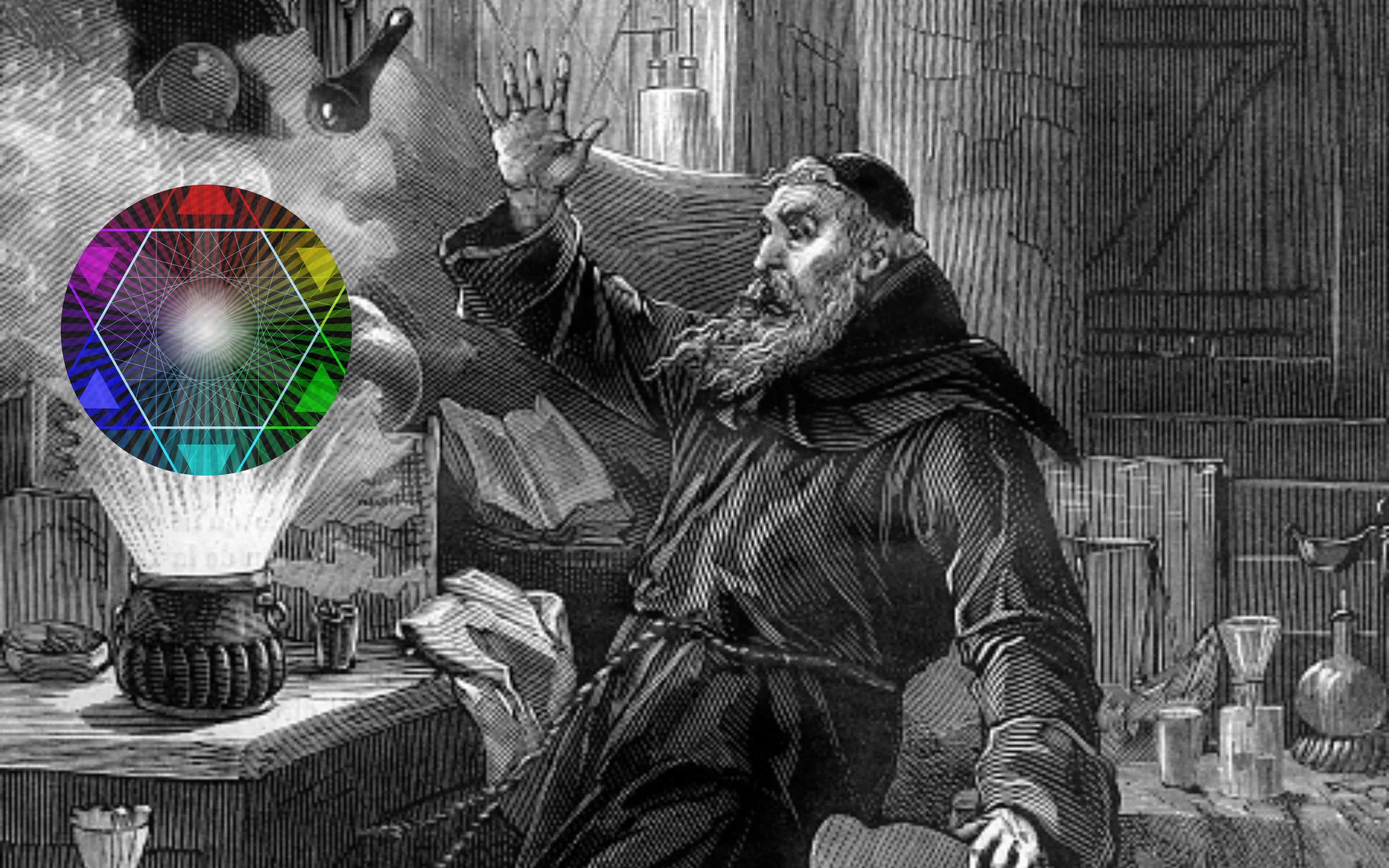
Historically, Alchemists have played a mysterious but important role, part mystic and part scientist, exploring the mysteries of existence with esoteric and unorthodox methods. In alchemy, the Magnum Opus, or ‘great work’ is the process of taking ordinary matter and converting it to gold. Here, the Alchemy of Color takes color as its subject matter, in a quest to understand the mysterious nature of color.
What is the alchemy of color? It is not a material thing, but rather it is philosophical gold, the knowledge of how to work with color to transform it from dross to gold, seeking the moments when color asserts its transcendent power, revealing the mysterious beauty of color, touching something that is deep inside all of us.

Experiencing color is easy, but working with it creatively is another matter entirely. Color and form are the two main components of any visual composition, and so every artist and designer is forced to address color and how to apply it to their work. That this happens from the very beginning, when a child is handed a box of crayons, belies the hidden complexity of color choice; It is assumed that this is a natural talent, a gift that some lucky few may have, while the rest of us look at a row of green crayons and grab one randomly and hope for the best.
Later on, we are introduced to color wheels, color palettes and color theory, all very authoritative, yet inscrutable. This extends to software tools, such as slider controls, color pickers and palette generators. There appears to be a logic that somehow remains elusive during the creative process, compelling practitioners to fill in the gaps with their own taste and ingenuity. Thus, we arrive at an age old maxim that seems as relevant now as it was when it was first spoken in the 19th century:
"Designers may be made, but colorists are born."
— Eugene Delacroix
This is where I found myself many years ago, a young digital designer who wanted to learn how to work with color. I found a Red Yellow Blue color wheel at my local art supply store, at first convinced by its appearance, only to be frustrated by the lack of results, and finding out later that it was the wrong tool entirely.
I did find one heroic color resource, Josef Albers and his book Interaction of Color. Unlike other color theorists, Albers emphasized personal experience and perception as a means of working with color. Albers’ inspiration led me on a journey through time between the distinct disciplines of color, the parallel traditions of art and science, and human experience of color in its many forms. This journey has led me to confront tradition and develop tools and methods that shatter many dogmatic and didactic assertions about color.

This is the basis for the first arc, Everything You Don't Know About Color, where I dispel common myths and beliefs about color. Specifically, from a practical artist's and designer's perspective of working with color. It turns out that much of the confusion around working with color is due to these myths and half truths we've inherited, and successful colorists today are still defined by Delacroix's observation. I hope to change that, and the first step is to examine the historical record and call out some key points that, while they may not be wrong, are hindering the creative process of working with color.
This is iconoclastic work; subverting the conventional wisdom and dominant paradigms that make up popular color knowledge. Only by doing this can the alchemy of color be revealed and unbound, a journey of transformational knowledge.
Onward!