



Newton’s iconoclastic discovery that all colors are contained within white light was just one of a long string of scientific triumphs for the great scientist. However, he then confidently overstepped the bounds of science, into philosophy.
The colors of the spectrum are in a gradient, an unbroken transition of colors from Red to Orange to Yellow to Green to Blue to Violet. In between are some indeterminate colors that are hard to name.
This is where Newton made a small but consequential overreach; he added a seventh color, Indigo, to the named list of spectral colors. But why? The answer is that he wanted to create a correspondence of 7, which was considered a divine number, and which also matched the number of tones in the major scale in music theory.
Previously, I characterized this doctrine of correspondences as a scientific trait, but in fact, it has its roots in alchemy. Alchemy was explicitly built on the doctrine of correspondences — the belief that everything in the universe is connected through hidden sympathies and analogies. Metals correspond to planets, planets to days of the week, colors to humors, humors to elements. The entire alchemical system is a web of correspondences held together by the conviction that if two things share a structural similarity, they participate in the same underlying reality.
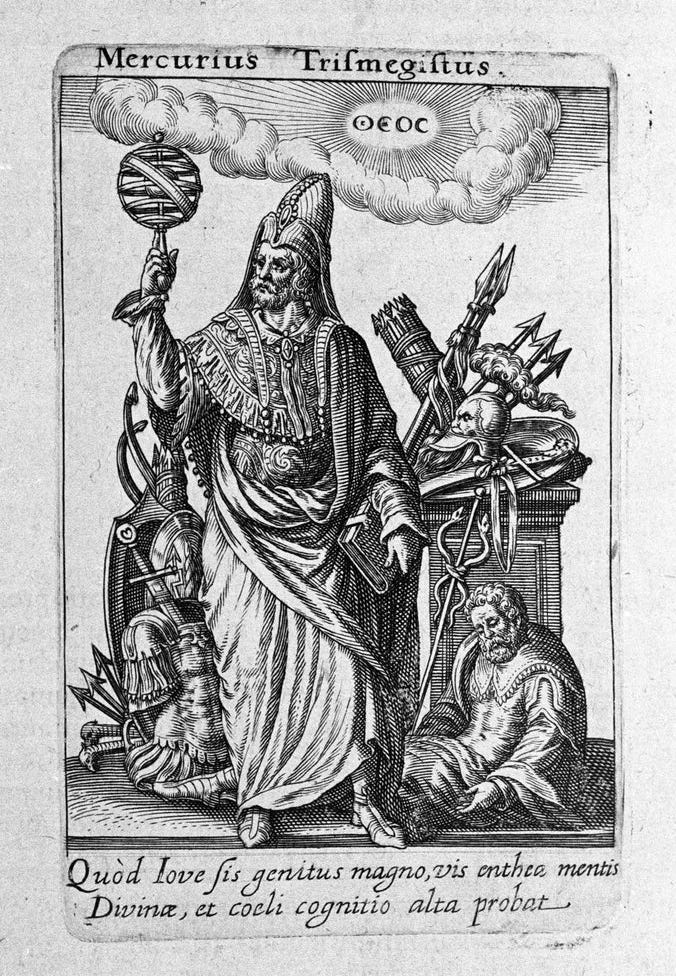
This is the root of Hermes Trismegistus' maxim — "As above, so below," the alchemical principle of concordance in its purest form. Newton the alchemist would have found the color-music concordance not just scientifically appealing but alchemically correct. Concluding that the spectrum has seven colors to match seven musical notes was confirmation that the universe was structured according to hidden harmonic laws, which is precisely what alchemy had always claimed. Color and music corresponding wasn't a metaphor; in the alchemical worldview it was evidence of a deeper unity. So Newton's overreach wasn't a departure from his alchemical thinking — it was an expression of it. The scientist and the alchemist were making the same move.
However, this correspondence is problematic because Indigo is not a perceptually distinct color — it's a region of the spectrum that most human eyes read as either deep blue or blue-violet. Color scientists and vision researchers have repeatedly noted that the average observer sees six bands in the spectrum, not seven.
Newton invented Indigo as a spectral color so he could add the color spectrum to the list of concordant natural phenomena, thus showing the perfection of the universe and its underlying mathematical structure. Newton bent science to fit the dominant philosophical framework of his day — Natural Theology. This is the belief that the natural world is God's creation and that scientific investigation reveals the perfection and mathematical order of divine design. Although Natural Theology was claimed by the Church, its roots are in alchemy, and the doctrine of correspondences.
This invention has reverberated through history up to the present day, where middle school science students learn the spectral colors of the rainbow by the mnemonic name ‘Roy G Biv.’
Now, as far as fudged scientific facts go, this one is pretty benign at first glance. What’s the harm in adding an extra color to the rainbow? Here’s the crux of the problem: Equating color with sound and music implies that there exists an ordered an invariable relationship of rules governing color relationships, just as what exists with sound and music theory.
The problem is that this is simply not true. Color relationships may be described by certain structures, but this does not mean that color harmony has an ordered mathematical structure.
Generations of scientists have made this mistake. And continue to do so.
To be clear, science has indeed described the physical characteristics of individual colors, and created systems that allow for the precise and consistent description and reproduction of individual colors. The problem is that even though these systems create an ordered arrangement of colors, the actual relationship between colors is not fully describable by scientific formulas.
This is a big, contentious statement that defies conventional and historic reason, but it is true, and I will show you why.

Let’s go back to the actual physical basis of color — the electromagnetic spectrum, where visible light and color exist as wavelengths of energy from approximately 380 to 700 nanometers, between infrared and ultraviolet. The spectrum is linear, and the color wavelengths can be measured scientifically.
Where color steps away from science and into theory and philosophy can be seen via another of Newton’s popular inventions — the color circle. What we now know colloquially as the ‘color wheel.’
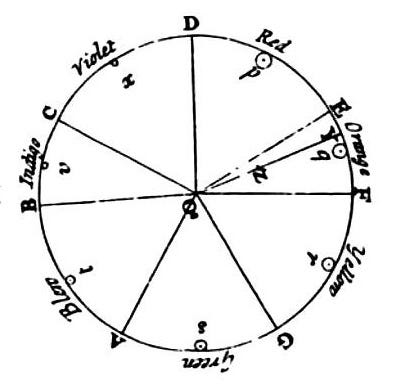
Here is Newton’s correspondence of color and sound, linking the musical scale (Dorian mode, starting on D) with the spectral colors:
Red = D
Orange = E
Yellow = F
Green = G
Blue = A
Indigo = B
Violet = C
Tellingly, Newton didn’t divide his color circle into seven equal wedges. He divided it into seven unequal arcs, sized to match the interval pattern of the Dorian scale; a whole tone got a wider arc, a semitone got a narrower one. The Dorian pattern (whole–half–whole–whole–whole–half–whole) puts its two semitones between E–F and B–C, meaning:
Red→Orange (D→E): whole tone → wide arc
Orange→Yellow (E→F): semitone → narrow arc
Yellow→Green (F→G): whole tone → wide arc
Green→Blue (G→A): whole tone → wide arc
Blue→Indigo (A→B): whole tone → wide arc
Indigo→Violet (B→C): semitone → narrow arc
Violet→Red (C→D, closing the octave): whole tone → wide arc
The reason Newton used the Dorian mode in the key of D is that he needed the scale’s two natural half-steps (E–F and B–C in an all-white-key scale) to land right after orange and right after indigo — that’s what let him squeeze seven named colors into a spectrum that doesn’t actually divide into seven equal parts. Starting on D was the specific choice that made the half-steps fall where his color scheme needed them. It’s forced, not observed — a scale bent to a hue-count Newton had already decided on, not a hue-count discovered by consulting music — all in the service of showing correspondance between music and color.
Now, the reason for using a circle, rather than a linear diagram is this: musical scales repeat at the octave, the eighth note from the root. Newton judged Violet to be related to Red, and therefore arranged his color spectrum in a circle so that the last color, Violet was next to the first color, Red, in a relationship that references the repeating nature of the octave in music. Newton made this visual leap in his color circle diagram, and so the color wheel was born from this invented correspondence, and has been in popular use ever since.
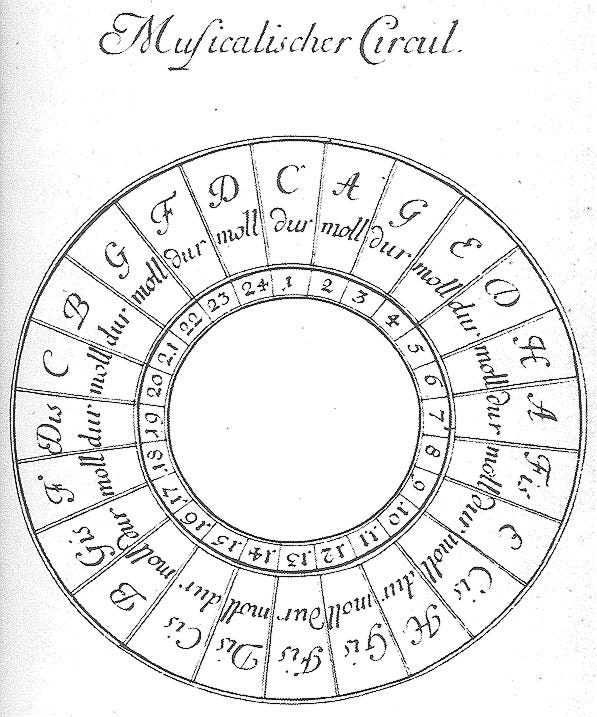
In an apparent instance of synchronicity, The circle of fifths was a musical innovation around the time Newton published Opticks, having been published independently by music theorist Nickolay Diletsky in 1677 and popularized by Johann David Heinichen starting around 1711, representing the 12 major and minor keys and their relationships as fifths.
Interestingly, Heinichen didn’t invent this idea purely from tonal logic, rather, he created it while searching for a way to visually represent ideas from Athanasius Kircher’s Musurgia Universalis, an hermetically influenced treatise on music, sound and universal harmony. Thus we can see yet another instance of rational discovery that was influenced by mystical means.

Newton noted that colors positioned opposite each other on his wheel showed the strongest contrast — an observation that would later be refined into the concept of complementary colors. But his own color circle, with its unevenly sized wedges bent to fit a musical scale, wasn’t built for that purpose. It would take later generations to rationalize the structure of the color circle to show this relationship.
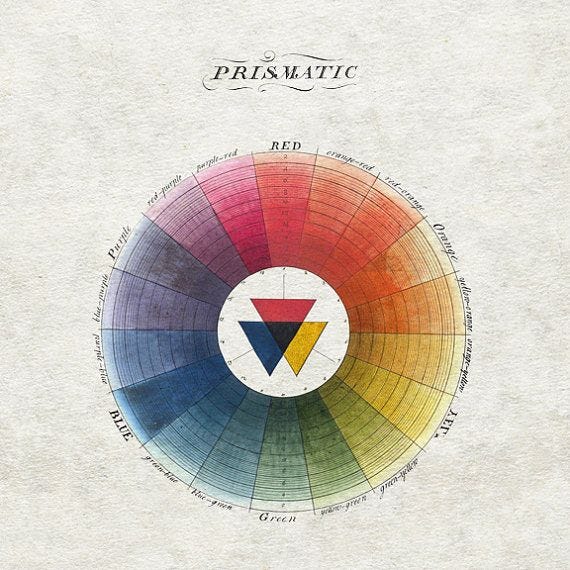
Color circles are so ubiquitous that people take them for granted, a source of truth. However, since the spectrum is linear, Red and Violet are not adjacent in nature — there is no physical reason they should connect. Newton connected them anyway, enclosing the spectrum into a loop.
Here lies the crucial fault: The circular form implies the system is complete and settled. It looks like a diagram of facts rather than a theoretical construction. That visual authority is arguably the wheel's most misleading quality. This implication has shaped color theory ever since.

Newton’s contributions to the understanding of color were true, monumental and lasting. Nevertheless, we have inherited a number of misconceptions that resulted from his work, both by his own overreach as well as subsequent generations of misinterpretation.
The core tension was set by the scientists’ drive to formulate laws of color relationships, as well as the philosopher’s desire to ascribe structure and meaning to color, and the human desire to describe the ineffable quality of the experience of color. As we move forward, we will see this invention and tension repeat itself time and again.
