"For the rays, to speak properly, are not colored. In them there is nothing else than a certain power and disposition to stir up a sensation of this or that color."
— Sir Isaac Newton
The perception of color is innate to the human experience, as it is tied to our evolutionary existence. This natural integration has fed the human desire to capture color and create with it. The earliest cave pictographs in Lascaux, France were done with color. And so, every culture since the beginning of humankind has incorporated color into the fabric of its society, with ever more sophisticated techniques and technologies.
To understand where we are now, in the 21st century, we must travel back in time, to find the threads of color thought that connect us to the past. This is the way to reveal the untold truths, the assumptions and the oversteps that have influenced and biased the ways we use color today — the way to finding everything you don’t know about color.

The true origin of colors was obscured for centuries. From antiquity, the origins of color were described largely from observation, reasoning and argument, as part of a larger framework of natural philosophy. The most important early figure was Aristotle, who held that all colors were derived from Black and White, defining this framework in his seminal work, de Coloribus, or On Colors.
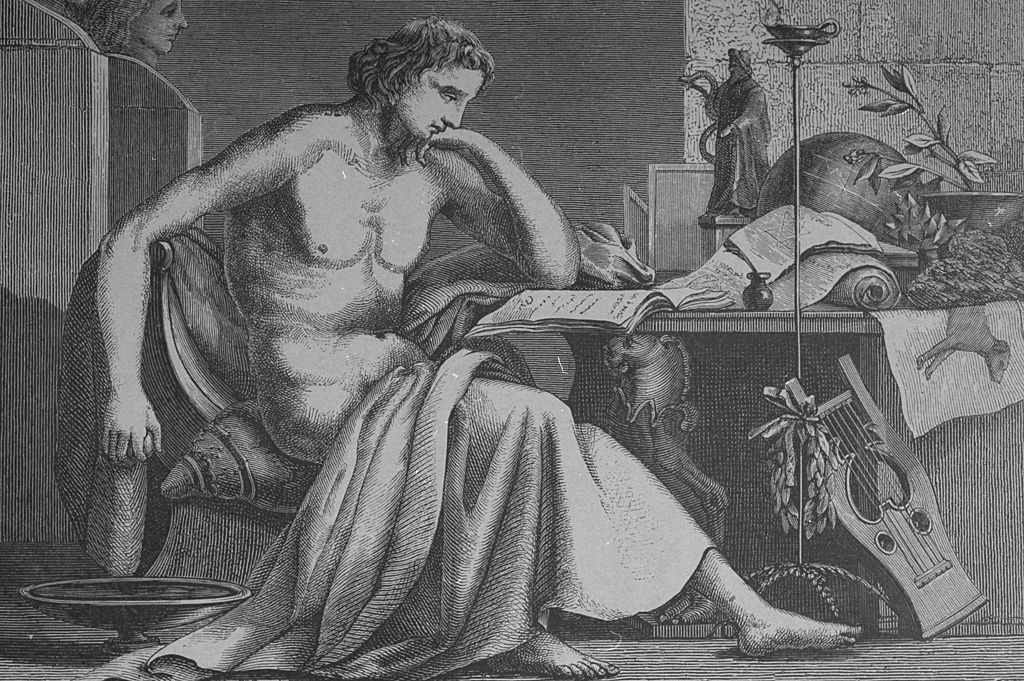
As a natural philosopher, Aristotle based his work on his observation of nature and deductive arguments based on philosophical notions, in what seemed to be common sense; water and air are naturally white, while gold is the color of fire. Light itself doesn’t have color, but all colors are visible because of it. Red is a mixture of light and black, and colors are created by varying mixtures of light and black. Color in living things is determined by the effect of moisture and dryness in combination with light and black.
Aristotle’s color theories solidified into canonical knowledge, so ingrained that they were absorbed whole into Scholasticism, the dominant mode of medieval philosophy. Thomas Aquinas united Aristotelian philosophy with Christian doctrine during this time, building the intellectual foundation and official position of the Christian Church. This position held for over four hundred years, until the time of Isaac Newton.

Isaac Newton was a giant of intellect, a polymath and original thinker who’s discoveries changed the course of history, as a physicist, mathematician, astronomer, inventor, thinker — and alchemist. He was a key figure in the Scientific Revolution that led to the Enlightenment; amongst his protean discoveries, he formulated the laws of motion and gravity, calculus, and foundational principles of optics. His observation of first principles combined with ingenious thinking overturned years of conventional wisdom and official dogma during his lifetime.
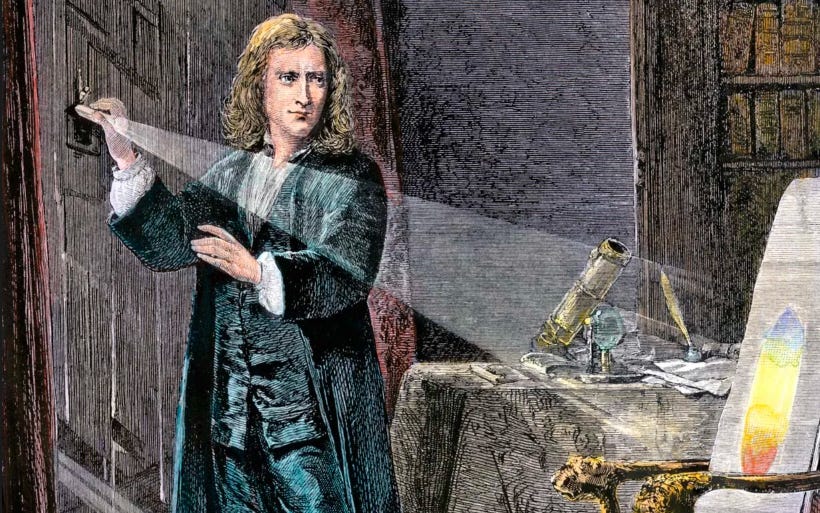
In 1666, the Black Plague was rampant, forcing Newton to seclude himself in his home laboratory while Cambridge was shut down. Working on his theories of optics, Newton began experimenting with prisms.
Prisms are familiar to everyone, casting the familiar rainbow gradient, and they were a well known curiosity during Newton’s day. However, the difference was that Newton thought differently, and his investigation was in an entirely different direction than the conventional wisdom that prisms merely modified or corrupted white light to produce colors.
Newton’s original proposition was the opposite — that white light was a composite of all colors, which the prism separated into bands. Crucially, Newton designed a set of experiments to prove his ideas; using two prisms, he was able to separate the spectral colors and then recombine them back into white light. Thus, Newton was able to prove that the prism did not, in fact, alter the color of the white light, because this recombination would not be possible if the first prism was modifying the original color. The conclusion being that colors were actually different refractions, or wavelengths, of light!

Here, we must pause and consider Newton, the man. Well known historically as the father of modern Science, he was also an avid Christian, and behind the scenes, he was a practicing alchemist. Over half of what Newton wrote concerned theology and alchemy. Newton devoted at least thirty years of his life to its intensive study, an estimated one million words devoted to alchemy, and most of it has never been printed.
Alchemy was the predecessor of Science, and influenced by natural philosophy and esoteric beliefs and rituals. Specifically, modern chemistry sprang from alchemy and its experiments with physically transforming substances and elements in rigorous and elaborate processes.
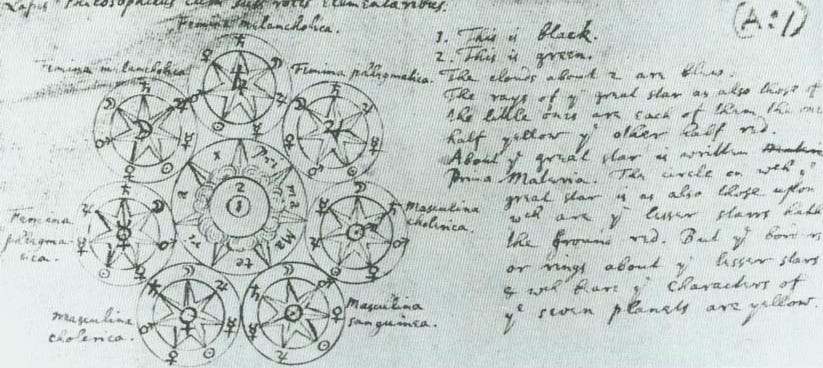
The modern view of alchemy tends to focus on the vain search for transmuting base substances into gold, and obscure practices that were part witchcraft. Newton himself used alchemy as another way to access and unlock the secrets of the universe.
Why was this secret? To start, knowledge was seen as dangerous, to be entrusted only to a select few adepts who had proven themselves to be capable of understanding and wielding this secret knowledge, while protecting it from being corrupted or dispersed into unworthy hands. Another reason why knowledge was dangerous was when it conflicted with authority, undermining official standards and positions.
As a seeker of truth, Newton was unafraid and prolific, yet cautious in public life. Privately, he rejected commonly held dogma and the established views of the Church. Newton’s heresies were numerous and could have cost him his positions at Cambridge and the Royal Society, so he kept this work hidden — another hallmark of alchemy.
Early scientists and free thinkers all ran the risk of running afoul of the Church, who’s position of authority in medieval times was absolute. As God’s representatives, their position was absolute and unquestionable, according to the doctrine of infallibility. Therefore, to question any of the intellectual framework of the Church, as defined by Aquinas and others, was to run afoul of God, and therefore be open to punishment.
This could take many forms. The story of Copernicus, Bruno and Galileo followed this arc, when Copernicus’ astronomical discovery that the sun is at the center of our solar system challenged the Church’s dogma that the Earth is at the center of the universe. The Church’s reaction was to ban Copernicus’ book, burn Bruno at the stake, and imprison Galileo. This was the regime of authority under which Newton worked secretly in his quest for knowledge — illicit or not.

There was another authority that both supported and suppressed Newton’s quest — The Royal Society. Founded in 1660, to promote and support scientific inquiry, it quickly gained patronage from Charles II and thus the support of the monarchy. Composed of the leading scientific minds from various disciplines, The Royal Society became a competitive proving ground for science, the debate of ideas and the weighing of evidence.
Robert Hooke was Newton's senior at the Royal Society and one of the most formidable scientific minds of the era. He was another polymath who made significant contributions to biology, physics, architecture and engineering. His strongly held views came into conflict with Newton’s in a fundamental way, about the nature of light; Newton held that light was composed of particles, while Hooke maintained that it was a wave.
Hooke refused to fully accept Newton’s theories because he declared that his own model could account for the same light splitting phenomenon. Ultimately, both were right, however, this wasn't resolved until the discovery of quantum mechanics in the 20th century. The dispute was never fully resolved in their lifetimes, but the conflict meant that publication was delayed for years while it played out.
So, from Newton’s first discovery in 1666, and his first submission to The Royal Society in 1672, his paper wasn’t published until 1704. Backed by the authority of the monarchy and the institutional prestige of The Royal Society, and presented as a scientific discovery instead of a theological argument, Newton’s discovery finally laid to rest the archaic conventional wisdom around the nature of color. This marked the end of the first epoch of color, but by no means did it end the debate around color.
Newton’s prodigious intellect enabled his discoveries, but it also led him astray in theorizing about color. In the next installment, we will examine where Newton overreached — and find the errors that persist to this day.