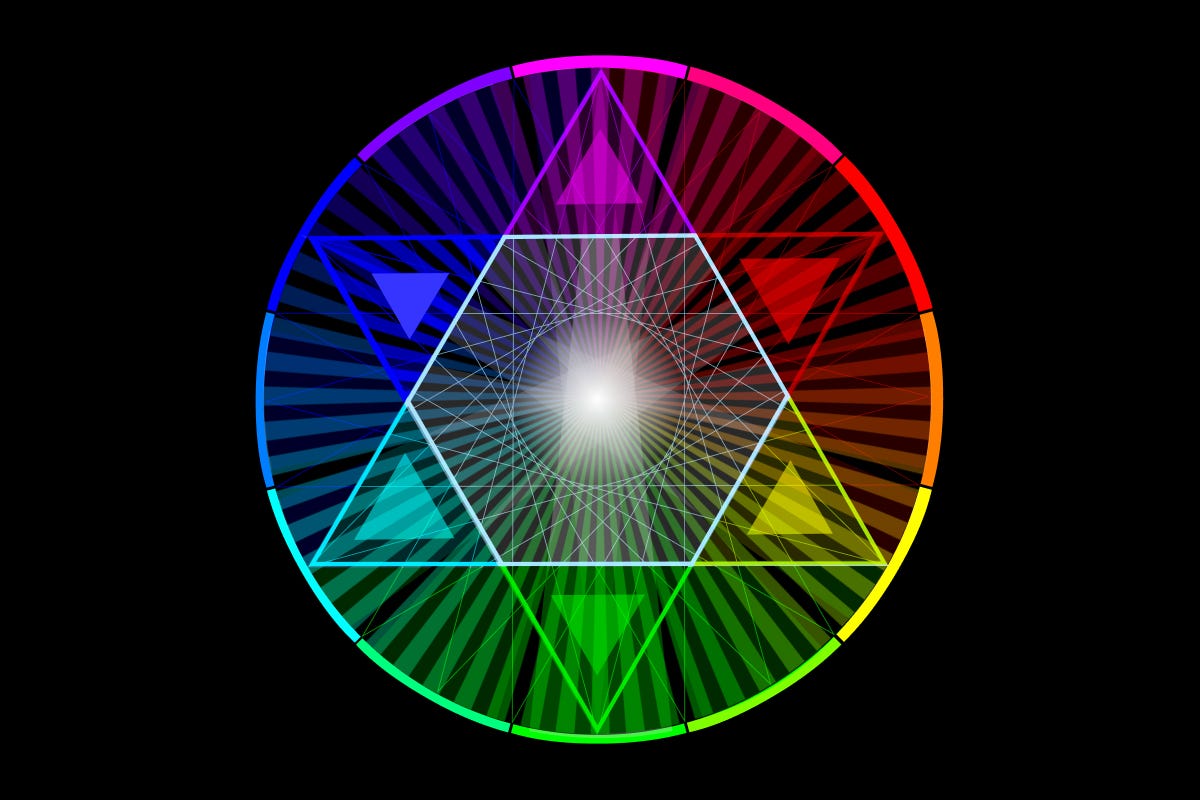
We last left off with a remarkable appearance of color alchemy, where it was revealed that Goethe’s apex color, Purpur, was a blue-red color closer to magenta than red — a color not found in the spectrum. This implies that Goethe’s color wheels and color theories may have been misinterpreted for years, with people mistaking Purpur for Red, and thus, Goethe’s color wheel resembled a regular painter’s Red Yellow Blue color wheel, when in fact, it was much more than that, layered with larger meaning and connected to mystical and philosophical resonances.
Newton, the color wheel and painter’s RYB color wheel are so ingrained that they subconsciously affect to the way we think about color. A major example being that, when most people describe colors today, we automatically begin by reaching for the colors of the spectrum: red, orange, yellow, green, blue and violet.
Of course, our color vocabulary runs far deeper than six words. Color naming is a cottage industry in its own right, with a fascinating link to psychology. (Why would someone name a color Dead Salmon? Someday, I’ll dive deeper into that subject.)
Color names also have a hidden pattern to them that shape how we make sense of color. For example, let’s take some well-known descriptive color names: Crimson, Plum, Navy, Teal, Chartreuse.
Whatever else these names carry, we subconsciously file them by hue (Crimson = red, Plum = purple, Navy = blue, Teal = blue-green, and Chartreuse = green). The hue is the category — everything else is qualification. That is the hidden assumption underneath our entire color vocabulary.
While we may think this is just common sense, it is, in fact, NOT the way colors have always been seen or described. Let’s go back in time to examine a different way of looking at color.
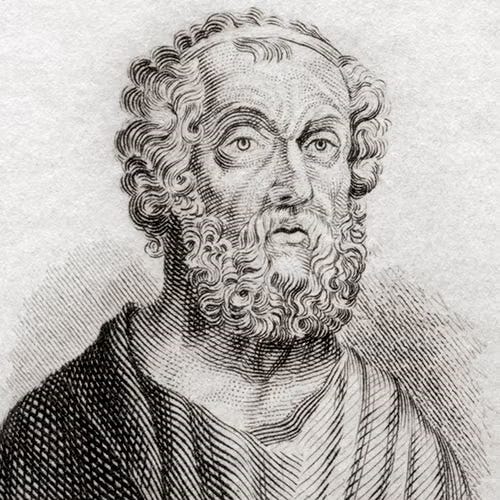
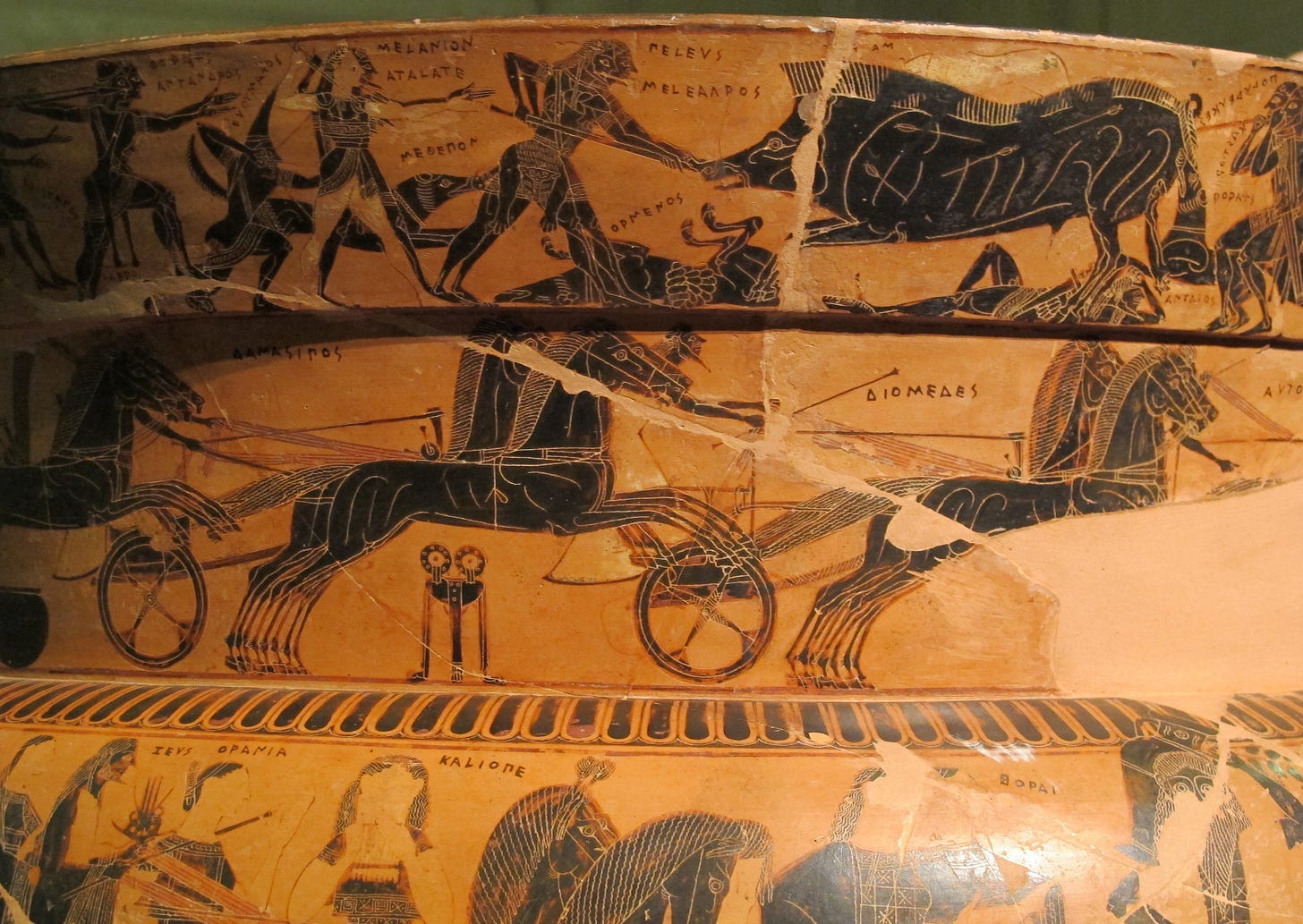
Have you ever heard that ‘the Greeks couldn’t see the color blue?’ This widespread (and misleading) statement is the result of historical confusion about color naming — and the influence of Newton.
In the mid 19th century, the Oxford classics scholar (and future prime minister) William Ewart Gladstone counted and classified every color word in the Iliad and Odyssey. His findings were this: adjectives indicating black appeared about 170 times, words indicating white about 100 times, other colors (red, yellow, green) only around 10 times each, and words directly indicating blue? Zero.
So, what was the catch? His counting was sound, but his frame of reference was not. He analyzed the ancient Greeks’ color descriptions from the Newtonian scientific perspective — the hue-based color naming associated with Newton’s discovery of the spectrum. And, not finding any analogue for blue, he came to this conclusion, in his own words: “the organ of colour and its impressions were but partially developed among the Greeks of the heroic age.” Over time, the meaning of this statement was elided into the provocative version you may have heard:
“The Greeks could not see blue.”
The truth here lies in how the ancients understood and described color, not that they were somehow physically different and were lacking in color vision. Rather than a hue-based system, such as Newton popularized, the classical Greek conception of color was a system based on Leukos / Melas or, light and dark, with the endpoints being black and white.
Leukos translates as “bright, shining, white," but it denotes complex layers of radiance and symbolic meaning, while Melas covers a range of dark colors from black to brown. These were considered characteristics of light, not surface. Notably, these were more than just descriptions of color, they also carried symbolic meanings around forces the Greeks associated with light and dark.
After Leukos and Melas, came Erythros, which maps to red in our conception. Beyond those three, its crucial to understand that the Greek conception of color is very different than our own, and so, it is difficult to map it on to our our own frame of reference.
Lampros, for example, meant bright or radiant, but carries a different meaning than brightness or saturation. It can be imperfectly characterized as a color-making ingredient that combines with Leukos and Melas to generate a quality of color.
Kyaneos most closely maps to black or dark blue, but is also characterized by luminosity (luster?).
Glaukos is a pale / low saturation but ‘gleaming’ range of blue green, used for olives, grapes, eye color, the sea, and clear skies. Neither cleanly describes a hue; Kyaneos is a degree of darkness, while Glaukos is a quality of pale gleam.
So, the main difference is this: The Greeks described colors primarily by luminosity (light / dark brilliance), rather than hue.
Ironically, the Greek color system appears to make sense if we view it as ingredients and recipes for the Alchemy of Color — with the difference being that these are ephemeral qualities, not elements!
Leukos and Melas combine to make Phaios (gray).
When Leukos combined with Lampros is poured into deep Melas, it produces Kyaneos.
Kyaneos mixed with Leukos gives Glaukos.
When Lampros is mixed with Erythros and Leukos, it creates Xanthos.
Erythros mixed with Melas and Leukos produces Alourgos (close to Tyrian purple); push these elements further, burn them more and add more Melas, and it becomes Orphninos — dark and dim.
The other major point worth making is that the Greek color system was generative, not descriptive, with colors emerging from energetic mixing of light and dark within certain conditions and proportions of other qualities.

This brings us finally back to Goethe; the foundation of his color theory was the interplay of light and dark, the very basis of classical Greek color theory, which comes as no surprise — Goethe extensively studied Aristotle, Empedocles, and Democritus, carrying forward what he judged to be true, and worth keeping.
Goethe was in alignment with the ancient Greeks in that he considered the appearance of color as being the result of an alchemical transformational interaction between qualities of light and dark as they intensify under the influence of a certain direction.
Goethe’s color theory is transitional; he does name hues, however, they were chosen for their brightness and relationship to black and white, another instance where his system was aligned to the Greek system of characterizing color, rather than the Newtonian hue-based conception of color.

Thus, Goethe’s conception of color was generative and complex, a sophisticated contemporary theory of color that had its roots in classical Greek color theory. And this put him in direct conflict with Newton and his hue-based color names and reduction of color to a band of the spectrum. This ‘Clash of the Titans’ still stands as a division point, but in our next installment, I will reveal where Goethe and Newton were actually in agreement — something that is rarely even known, much less acknowledged.